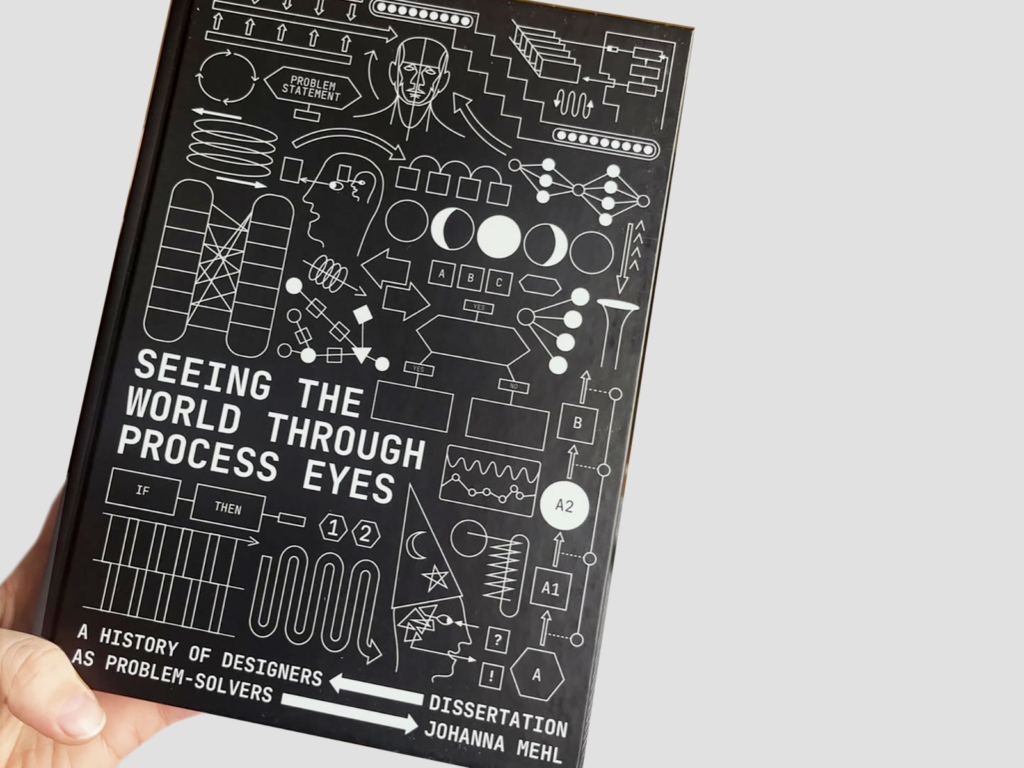
In her dissertation “Seeing the World Through Process Eyes: A History of Designers as Problem-Solvers”, Johanna Mehl explores the intellectual history of design as a universally applicable problem-solving model. Using the "process" paradigm, Mehl critically examines solution-oriented design at the intersection of design theory, cultural studies, architectural history, and science and technology studies (STS).
In July 2026, Johanna Mehl, a former research collaborator at the Köln International School of Design at TH Köln and co-editor of the open-access book Attending [to] Futures: Matters of Politics in Design Education, Research, Practice, successfully defended her dissertation. Entitled Seeing the World Through Process Eyes: A History of Designers as Problem-Solvers, her doctoral thesis was awarded the highest distinction, summa cum laude. The dissertation was supervised by Prof. Dr. Orit Halpern (TU Dresden), Prof. Dr. Carolin Höfler (TH Köln) and Prof. Greg Castillo, Ph.D. (University of California, Berkeley).
Mehl’s central thesis posits that examining environmental design practices and concepts that emerged at the University of California, Berkeley, in the late 1960s and 1970s offers a critical, contemporary perspective on design’s role in global crises. Mehl aims to deconstruct the idea that technological design solutions are an obvious response to global challenges. In doing so, she reveals the historical contingency and epistemological premises underlying this notion.
Mehl examines an epistemological shift that reshaped intellectual thought, especially in cybernetics, starting in the mid-20th century. This shift is related to the postwar development of design as an emerging discipline. It signifies a change in focus from determining what is “true” or “false” to understanding how things and processes work. This transformation created epistemological and professional gaps. As Mehl demonstrates, these gaps were filled by new figures at the intersection of design and cybernetics, such as Buckminster Fuller, who envisioned the role of the “comprehensive designer”. These design figures were attributed a particular aptitude for underlying processes, pattern recognition, and creative thinking. The scope of their work expanded substantially, shifting from shaping industrial environments to planning global systems. Their work evolved from focusing on individual objects to encompassing the entire planet. This transition resulted in a primary focus on designing global processes and governance systems.
Mehl’s historical and contextual analysis is thus an indispensable key to understanding the current design crisis, which oscillates between a desire for improvement and a technological fix. It asks how design can evolve from being an accomplice to global crises to actively shaping their resolution.
We hereby express our heartfelt congratulations to Johanna Mehl for her exceptional accomplishment.
Image: Johanna Mehl